
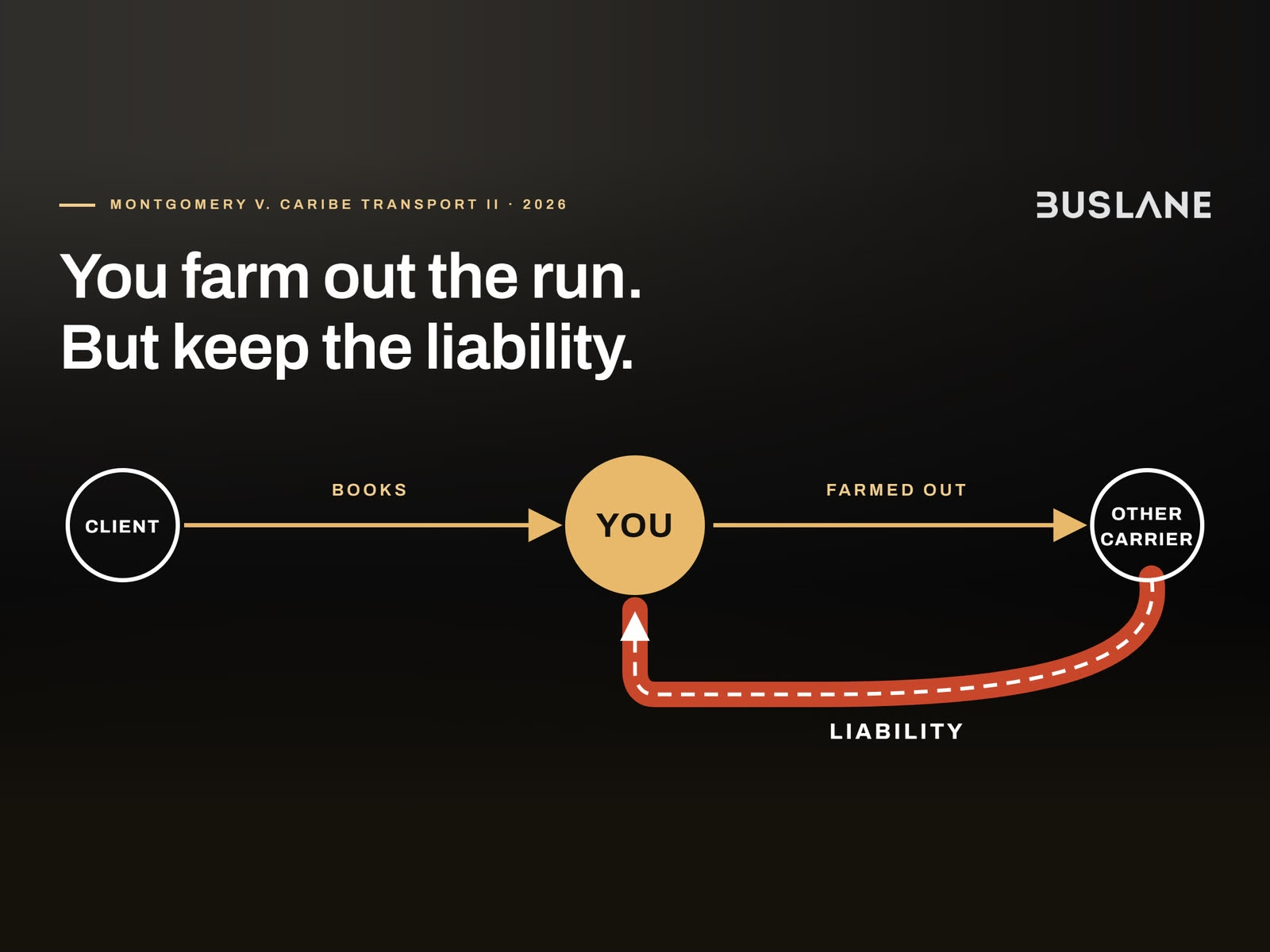
Farming out a charter to another company is normal in this industry. You're overbooked, you're short a vehicle, a driver just called out, so you hand it to a competitor you trust, to preserve the client relationship, and move on. Everybody does it. Nobody thinks twice about it.
Here's the problem: legally, that's not really operating a charter anymore. It's brokering one. And brokering just got a lot more dangerous.
What Montgomery actually changed
On May 14, 2026, the Supreme Court decided Montgomery v. Caribe Transport II, LLC, a unanimous ruling holding that federal law (the FAA Authorization Act) does not shield freight brokers from state lawsuits when they negligently select an unsafe carrier. Brokers had spent decades arguing federal preemption made them untouchable if the carrier they picked caused an accident. The Court said no: if you select who does the job, you can be sued directly for negligent selection, on top of whatever claim exists against the carrier itself.
Ten weeks later, on July 23, 2026, a Dallas County jury put a number on what that looks like in practice: $604 million against C.H. Robinson, the country's largest freight broker, arising out of a fatal Mississippi pileup. The case had been in litigation since the 2021 crash and was already close to trial. Montgomery simply cleared away C.H. Robinson's preemption defense while the case was in the pipeline, which is why a verdict landed ten weeks after the ruling instead of years later.
The jury split fault 45% to the driver, 32% to the carrier, and 23% to C.H. Robinson. The broker ate roughly a quarter of a $604 million verdict without ever owning the truck or employing the driver. C.H. Robinson has announced it will appeal.
Justice Kavanaugh's concurrence in Montgomery is the clearest statement of the new rule: if a company "can be held liable for disregarding poor safety records, they have a strong incentive to do business only with safe and reliable motor carriers." Diligence is the shield now. Not a disclaimer. Not a rating on a government website. An actual, ongoing record of asking the hard questions and checking the answers.
Why this isn't just a freight-broker problem
Montgomery was a freight case. But the doctrine it applies, negligent selection of a motor carrier, doesn't distinguish between hauling cargo and hauling people, and it doesn't require you to hold yourself out as a "broker" to be treated like one.
Look at what actually happens when a bus company can't fulfill a charter and hands it to another carrier: it's selecting a motor carrier on behalf of a client, usually for a markup or to protect the relationship, without owning the vehicle or employing the driver on that job. That's not a loose analogy to brokering. It's the definition of it. The label on your DOT authority doesn't change what a plaintiff's attorney will call the transaction after an accident.
That makes the operator who subcontracts more exposed than people realize, for reasons that stack on top of each other. A professional operator is held to a higher standard of care than a lay customer. A jury will have little patience for "we didn't check" from a company that knows exactly what an FMCSA rating and a BASIC score are. And if the original client wasn't told the job got handed off, there's a second problem sitting on top of the negligent-selection claim: the client contracted for your service, not a stranger's, which opens the door to breach of contract and misrepresentation theories that a straightforward broker transaction doesn't carry.
The answer isn't better paperwork. It's a different transaction.
Document your existing handoffs more carefully and you've still got the same exposure: a professional standard of care, a broker-like fact pattern, a possible non-disclosure problem, just with a thicker file to produce in discovery. That's not a fix. It's a slower way to lose.
The actual fix isn't to trust less. It's to trust but verify. Every time a charter moves from one company to another off the books, a phone call to a friendly competitor, a text to whoever has a bus free, the whole arrangement runs on trust and nothing else. Nobody's checking. Everybody's just hoping the other guy is as careful as they'd be.
Route that same job through the Buslane operator platform instead, and the trust doesn't go away. Verification gets built into the transaction instead of depending on someone remembering to do it.
This doesn't make Buslane a broker. We don't price the service, we don't own the customer relationship, and the company doing the booking chooses which operator gets the job, not Buslane. What Buslane provides is the infrastructure underneath that choice: the vetting data, the payments, the messaging, standardized terms that codify the rules into one agreement for both parties, and a record that gets generated automatically instead of chased down after the fact. Infrastructure makes the decision easier to get right, then gets out of the way.
Trust alone doesn't hold up, even when it's earned
C.H. Robinson had used that carrier for nearly 270 prior loads before the crash, and the carrier held a Satisfactory FMCSA rating when it was selected. By any normal business measure, that's a long, established, trusted relationship with a company that looked clean on paper.
It didn't matter. Reporting on the case indicates the carrier's out-of-service rates were well above where you'd want them, sitting underneath a rating that still read Satisfactory. That's the gap worth understanding: the top-line rating is a slow-moving summary, while the granular data underneath it is where problems show up first. A track record isn't a legal defense. A documented, continuously updated verification process is.
When you farm out through the platform, you're not just picking a carrier. You're able to point to something concrete: a documented, continuously updated safety record on that carrier, generated independently of you, that existed before you made the call. That's the difference between "we trusted them" and "here's what we relied on," and it's the second one a jury actually credits.
What to check before your next farm-out
If you're going to keep doing this the old way, do it with your eyes open. At minimum, before you hand a job to another carrier:
- Pull the SAFER Company Snapshot and confirm the operating authority is active and there's no out-of-service order. A company can look fine on the phone and be prohibited from operating that week.
- Look at the BASIC percentiles, not just the rating. The rating is the summary. Unsafe Driving, Crash Indicator, Hours-of-Service Compliance and Vehicle Maintenance are where trouble shows up first, and passenger carriers are measured against tighter thresholds than freight haulers.
- Get the insurance certificate and read the limits. Federal minimums run to $5 million for vehicles designed to carry 16 or more passengers, and less below that, but requirements change and your own contract may demand more. Confirm it's current, not last season's copy.
- Put the arrangement in writing rather than settling it over text.
- Tell the client the job is being handed off. This one costs you nothing and closes off the breach-of-contract and misrepresentation theories that stack on top of a negligent-selection claim.
- Save what you looked at, with the date. A screenshot from before the trip is worth more than a memory afterwards.
That's the honest version of doing it manually. It's also a real amount of work to repeat for every handoff, every time, forever, which is exactly why it usually doesn't happen.
The choice most operators think they're stuck with
Stop farming out entirely, and you're handing your best clients straight to a competitor who's happy to keep them. Keep farming out the way it's always been done, and you're hoping everything goes well while exposed to the kind of verdict that ends a company.
There's a third option now: keep the client relationship and the revenue, and mitigate the liability instead of hoping it never comes up.
Here's how it works. Every operator's FMCSA operating authority status, out-of-service orders, safety rating, and percentile scores across the six BASICs that apply to passenger carriers (Unsafe Driving, Crash Indicator, Hours-of-Service Compliance, Vehicle Maintenance, Controlled Substances and Alcohol, and Driver Fitness) get checked daily against the stricter thresholds that apply to passenger carriers. Every check is logged and timestamped, and the raw data is archived by date, so the record is contemporaneous rather than reconstructed after something goes wrong.
Cross a threshold, drop below a Satisfactory rating, or lose your insurance, and it isn't a note in a file. It's an automatic suspension, and reinstatement only happens once the deficiency is actually cured, not just explained away.
We've built this into Buslane's foundation, not bolted it on top. Trust but verify is the actual operating philosophy of the company and the brand. It's the thing that makes farming out a charter through Buslane the obviously safer call, not just the more convenient one. In an industry where a Satisfactory rating just proved it means very little in front of a jury, that's the differentiator that matters.
The custom of farming out charters to friendly competitors isn't going away. What we're building is the version of it that doesn't leave you holding the liability if it goes wrong.
If you run buses and this sounds like a problem you've been quietly carrying, get in touch and I'll walk you through it. If you want the longer story of why I built this after 27 years of running charters myself, start here.
This post reflects our own analysis of a recent Supreme Court decision and does not constitute legal advice. Operators should consult qualified counsel about how this applies to their specific business.
Sources:
- Montgomery v. Caribe Transport II, LLC, 608 U.S. ___ (2026), slip opinion
- Case summary (Justia)
- C.H. Robinson's own statement on the verdict, confirming the carrier's Satisfactory rating and prior load history
- "C.H. Robinson hit with huge nuclear verdict in a post-Montgomery world," FreightWaves
- "Post-Montgomery $600M aftershock rocks C.H. Robinson," Land Line
- "C.H. Robinson to Appeal $604 Million Freight Broker Liability Verdict," Commercial Carrier Journal