
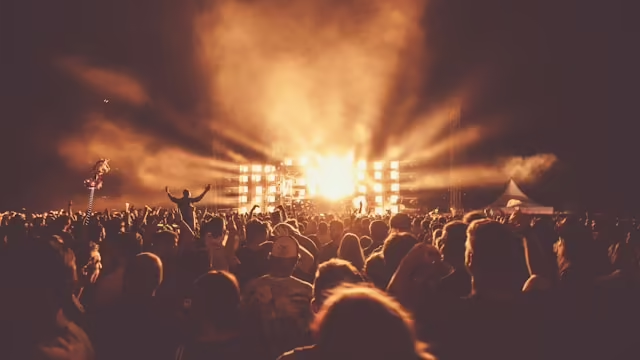
Getting thirty people to a sold-out show at Climate Pledge Arena is genuinely straightforward — if you have a plan. Without one, you're looking at a Tetris puzzle of rideshare surge pricing, split groups, and a post-show reunion on a dark corner with half your party still inside.
Seattle's three major indoor and outdoor event venues — Climate Pledge Arena, T-Mobile Park, and Lumen Field — sit within roughly two miles of each other in the Lower Queen Anne and SoDo neighborhoods. Each one handles charter bus arrivals differently, and understanding those differences is the difference between a smooth group night out and a 45-minute post-show meltdown.
This guide covers the logistics for all three venues: timing, drop-off approach, bus staging, and how to structure a full-night itinerary that handles dinner, the show, and an after-party in one booking.
Why a Charter Bus Makes Sense for Concert Groups
The math is simple. A rideshare for a group of 20 from Capitol Hill to Climate Pledge Arena costs $15–$25 per person each way — call it $600–$1,000 round-trip, with surge, before anyone's had a drink. A minibus carrying that same group runs $125–$200/hr; even a 4-hour booking ($500–$800) keeps everyone together, eliminates surge unpredictability, and gives you a guaranteed ride home when every Lyft in a three-mile radius just got requested at the same moment.
For the larger groups that fill a charter bus (50–56 passengers, $150–$275/hr), the per-person savings are even more pronounced. Split across 50 people, a 5-hour charter-bus night comes to roughly $15–$27 per person — comparable to one rideshare leg, for the whole night.
The less-obvious benefit: a charter bus creates a shared pre-show experience. Loading the bus at the same pickup point, having drinks and music en route, and arriving together sets a different tone than trickling in from seventeen separate cars. For birthdays, corporate outings, and any occasion where the group is the point, that shared ride matters.
Get a group transport quote for your next Seattle concert or event.
Climate Pledge Arena: Concerts, Kraken Games & Seattle Center Traffic
Climate Pledge Arena sits inside the Seattle Center campus — 74 acres of event space, green lawns, and pedestrian plazas bordered by Mercer Street to the north, 1st Avenue N to the east, and Thomas Street to the south. That setting is beautiful and entirely hostile to large vehicles at showtime.
Drop-off approach: Charter buses typically drop off on the campus perimeter rather than pulling onto the central pedestrian paths. 1st Avenue N and Mercer Street are the most common access corridors; your operator will confirm the current preferred drop zone, which can shift based on city permits for specific events.
The timing challenge: Seattle Center is served primarily by Mercer Street and the SR-99 Aurora Avenue corridor, and both back up quickly on event nights. On a weeknight show, plan for 90 minutes of travel time from most Seattle neighborhoods. Coming from the Eastside — Bellevue, Redmond, Kirkland — add another 30 minutes and route through SR-520 rather than I-90/SoDo, which routes toward the wrong side of downtown. Friday and Saturday nights should be treated as 2-hour minimums.
Post-show logistics: Seattle Center's pedestrian-first design means your group will be walking to the pickup point rather than stepping off a curb into the bus. Designate a specific, named landmark — not just "the front of the arena" — and agree on a meeting time 20 minutes after the stated show end. Shows that run long push that window; build cushion.
Kraken games vs. concerts: NHL games have predictable 7 p.m. starts and relatively consistent end times (2–2.5 hours for regulation play). Concert timing is less predictable — openers, set changes, and encore decisions all affect when your crowd actually exits. Budget a 30-minute buffer on top of the published show length for post-show bus staging and group assembly.
T-Mobile Park: Mariners Games & Stadium Concerts
T-Mobile Park anchors the SoDo district just south of downtown, in a neighborhood built around its commercial street grid. The stadium hosts Mariners baseball April through September, plus several major stadium concerts each year (past headliners have used the field-configuration setup that opens capacity to 45,000+).
SoDo's advantage for charter buses: Unlike Seattle Center, SoDo has wide commercial streets and multiple surface lots developed specifically to handle large-vehicle event traffic. The area around 1st Avenue S and Edgar Martinez Drive S gives operators more staging flexibility than the Queen Anne approach to Seattle Center.
Timing: Mariners games typically start at 7:10 p.m. on weeknights; summer afternoon games shift the entire timeline. For weeknight games, leave your origin point 75–90 minutes before first pitch. Stadium concerts at T-Mobile can draw much larger crowds than a typical game; treat those evenings like a Lumen Field event in terms of traffic planning and add 15–20 minutes.
The SoDo bottleneck: Post-event, the 4th Avenue S and Airport Way S corridors are the primary vehicle exit routes. On sellout nights, plan for 20–30 minutes of post-show traffic before the bus clears the neighborhood. That's normal — not a logistics failure — and your driver will know the fastest exit route.
For a combined Mariners game plus waterfront dinner, the bus routing works naturally: pickup from hotel or neighborhood, drop off at T-Mobile, head to the waterfront post-game, then home. Seattle city guide has more on waterfront-area logistics.
Lumen Field: Concerts, Seahawks & Sounders
Lumen Field sits immediately south of T-Mobile Park, separated by Edgar Martinez Drive. It hosts Seahawks NFL games, Sounders MLS matches, and several of Seattle's biggest outdoor concerts each year — a configuration that can seat 68,000 for music events.
Charter bus logistics at Lumen Field are well-documented and well-rehearsed. The venue's commercial vehicle drop-off and staging protocols are more established than the other two venues precisely because it handles the highest event volumes. If this is your primary destination, read our dedicated Lumen Field charter bus parking guide for staging-specific detail; this article covers the comparison context.
Concert configuration vs. game day: Lumen Field concert setups often reconfigure the field and can require different pedestrian egress routes than a standard game day. That matters for post-show pickup: the exit flow you saw at a Sounders match may be different for a stadium concert. Confirm pickup logistics with your operator a few days before a concert booking.
The SoDo pairing opportunity: When your group has tickets to a T-Mobile Park concert AND wants to extend the night to a SoDo bar strip, one bus can cover the full arc without repositioning. This is the multi-stop itinerary structure we discuss below.
Structuring a Full Concert Night Itinerary
The most common request Buslane gets for concert groups is a full-night booking: dinner first, venue for the show, after-party to close. Here's how to build that itinerary so your quote is accurate and your night runs on time.
Step 1 — Map every stop with addresses. Don't say "dinner in Capitol Hill." Give the restaurant address. Vague itineraries get padded quotes; specific ones get accurate ones.
Step 2 — Estimate time at each stop. A sit-down dinner: 75–90 minutes. Venue: stated show length plus 30 minutes for exit and group assembly. After-party bar: however long you want — just tell the operator, because that time is billed.
Step 3 — Add the transit windows. Seattle's event nights are not the time to assume 15-minute drives. Build realistic transit time between each stop: 20–25 minutes within downtown/Capitol Hill/SoDo, 35–45 minutes if you're crossing I-90 or going north of the ship canal.
Step 4 — Build in a staging fee conversation. For shows over 2 hours, the bus can't idle in a no-parking zone indefinitely. Ask the operator about off-site staging and any associated fees. Most operators build staging into their hourly rate; some charge separately for lots. Know which you're getting.
Step 5 — Confirm one pickup point for the end of the night. Everyone agreeing where the bus is before the show starts eliminates a chaotic group text at midnight. Pick a landmark, name it, tell everyone. The driver will be there at X time; stragglers can walk to meet the bus rather than the bus hunting for stragglers.
Plan your concert group transport — get a custom quote.
Choosing the Right Vehicle for Your Concert Group
Vehicle selection for a concert night follows the same capacity bands as any group outing — but with two concert-specific considerations: you may want more luggage space if the group is coming from different neighborhoods with coats and bags, and a party-bus configuration (15–40 passengers, $200–$500/hr) trades some seating for an onboard social setup that extends the event experience onto the vehicle.
| Group size | Best vehicle | Capacity | Hourly rate |
|---|---|---|---|
| 8–14 | Sprinter Van | 8–14 | $150–$250/hr |
| 14–24 | Shuttle Van | 14–24 | $100–$175/hr |
| 24–35 | Minibus | 24–35 | $125–$200/hr |
| 15–40 (social focus) | Party Bus | 15–40 | $200–$500/hr |
| 50–56 | Charter Bus | 50–56 | $150–$275/hr |
For groups between 36–49, the honest answer is two minibuses or a step up to a charter bus — there's no single vehicle in that exact band. Both options work; a charter bus keeps the group together but the per-hour rate is higher.
If your concert group is also a sports group — corporate suite holders, for example, who go to games all season — a standing relationship with an operator that knows your venues eliminates the re-quoting cycle each time.
Coordinating Multi-Pickup Concert Groups
Concert groups rarely all live in the same neighborhood. A group of 30 where half are in Capitol Hill, a quarter are in Fremont, and the rest are hotel guests downtown presents a multi-stop pickup challenge.
Two-stop pickups are standard and easy to quote. Tell the operator: "First pickup at X address at 5:45 p.m., second pickup at Y address at 6:10 p.m., arrive venue by 6:45 p.m." The operator routes accordingly.
Three-stop pickups require scrutiny. Each additional stop adds 15–25 minutes of travel time and some organizational overhead (people who aren't ready, traffic at the second stop). For groups where pickups are spread across the metro, consider a central meeting point — a hotel lobby, a neighborhood bar, a parking lot — and have everyone converge there first. One pickup, zero coordination risk.
Hotel groups: For groups staying downtown, a lobby pickup typically works cleanly. Downtown Seattle to any of the three venues is under 2 miles; traffic is the variable, not distance. Use the timing guidelines above.
What Separates a Good Concert Group Transport from a Stressful One
The groups that have a great time on charter-bus concert nights all do a few things consistently:
They confirm the post-show meeting spot with the whole group before the show starts. Not during, not after. Before. One text to the group chat at dinner: "Bus picks us up at [landmark] at 11:30 p.m. Be there." Done.
They give the driver a phone number that will be answered post-show. If the group is running late, the driver needs to know. Designate one person (not the person most likely to be at the front of the pit) as the driver contact.
They book for more time than they think they'll need. Going long at dinner and wanting to extend the after-party are both things that happen. Operators can often accommodate overtime on the night if the driver's schedule allows, but the per-hour rate for unplanned overtime is typically higher than the base rate. Build the cushion into the booking.
They choose staging transparency over surprise. Before signing off on a quote, ask the operator: where will the bus stage during the show, and is there any staging fee? A clear answer means no surprises at invoice time.
Seattle's event calendar runs year-round, and all three venues have active booking seasons from spring through fall. Summer weekends at T-Mobile and Lumen Field, hockey season at Climate Pledge Arena, and the handful of arena and stadium concerts that anchor the city's event calendar are all bookable well in advance — and well-organized groups consistently get better vehicles at better rates than last-minute callers.