
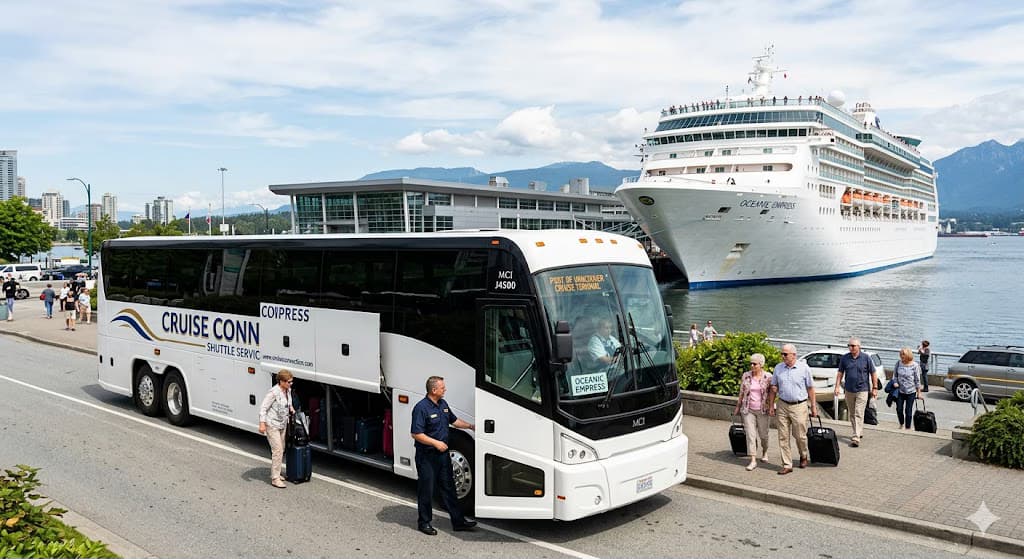
Every summer, roughly a million cruise passengers flow through Seattle's Pier 91 — the Smith Cove Cruise Terminal — on their way to Alaska. Most of them are traveling in groups: family reunions, friend trips, corporate incentive travel, multi-generational getaways. And most of them underestimate how much logistics it takes to get 20 or 40 people, their luggage, and their cruise documents from a downtown Seattle hotel to the terminal with time to spare.
This guide covers the Pier 91 group transfer in practical terms: the drive from major Seattle hotel zones, how boarding windows actually work, what it takes to handle a full group's luggage, and how to coordinate both the outbound and the return. If you're the person your group is counting on to get this right, here's what you need to know before you book.
What Pier 91 Actually Is
Pier 91, officially the Smith Cove Cruise Terminal, sits on the north shore of Elliott Bay about 1.5 miles northwest of downtown Seattle. It's a purpose-built cruise facility — dedicated drop-off lanes, covered check-in halls, and security screening before the gangway. The terminal handles large Alaska cruise lines running the Inside Passage itineraries out of Seattle, and during peak Alaska cruise season (roughly May through September), it's one of the busiest cruise embarkation ports on the West Coast.
The facility is not complicated to navigate, but it is unforgiving on timing. Cruise lines set boarding windows — specific time ranges during which passengers are expected to check in — and those windows close well before sailing. Missing your window doesn't mean a casual late check-in; it can mean standing by while earlier-boarding passengers fill the ship and your group's embarkation gets pushed to the final minutes, or, in rare cases, missing departure entirely.
That's the core reason groups need to think carefully about ground transportation. The margin for error is real.
The Drive from Downtown Seattle: What You're Actually Working With
From the major downtown hotel zones — Pike Place area, Capitol Hill, South Lake Union, Belltown — Pier 91 is a 15–20 minute drive in light traffic. The route goes north on Western Ave or Elliott Ave W and then into the terminal access road at Smith Cove.
The problem is that Seattle summer mornings are not light traffic. Embarkation days for large ships tend to cluster on Saturdays and Sundays, when the city is already dealing with weekend street activity, farmers markets, and general downtown congestion. Add a full charter bus navigating the Belltown and Magnolia approaches and you can realistically be looking at 30–45 minutes in peak summer conditions.
The practical rule for groups: leave at least 60–75 minutes before your boarding window opens. That buffer covers the drive, unloading luggage from the vehicle, porter check-in at the terminal curb, and getting your group through security and into the check-in hall. If your boarding window opens at 11 a.m., your bus should be pulling away from the hotel no later than 9:45 a.m.
For groups at hotels farther from downtown — the University District, Bellevue, the airport area — add another 20–30 minutes to that estimate.
Luggage: The Complication That Sinks Taxi Plans
A group of 20 going on a 7-night Alaska cruise generates an extraordinary amount of luggage. Most passengers check one or two large bags with the ship (tagged and handled by porters), carry a personal bag, and have a day bag for the first boarding afternoon. For 20 people, that's potentially 40 large checked bags, 20 carry-ons, and 20 day bags — all of which have to get from the hotel to the terminal in one move.
This is where taxis and rideshares fall apart at scale. A standard rideshare sedan holds 3 passengers with bags before it's full. Getting 20 people and their cruise luggage to Pier 91 via rideshare means booking 6–8 cars simultaneously, coordinating multiple departure times, and hoping none of them cancel at 9 a.m. on a busy Saturday. It also means your group arrives in a fragmented stream over 20–30 minutes — which matters when boarding windows are narrow.
A charter bus solves this completely. Full-size charter coaches (50–56 passengers) have undercarriage luggage bays sized for exactly this kind of volume — a 1:1 bag-to-passenger ratio is typical and usually well within capacity. The entire group loads once, departs once, and arrives together with all luggage accounted for.
For smaller cruise groups, a minibus (24–35 passengers, $125–$200/hr) has proportionally sized luggage compartments. For groups of 15–24, a shuttle van ($100–$175/hr) covers most luggage scenarios — but if your group is heavy packers, confirm cargo space with your operator at booking.
Cost Breakdown for the Outbound Transfer
Charter bus pricing uses a 3-hour minimum at the all-in job minimum of $1,250–$1,500. For most Pier 91 transfers — hotel pickup, drive to terminal, driver on standby for post-drop return — a 3-hour window is the right booking unit anyway.
| Group size | Vehicle | Rate | Typical booking | Approx. total | Per person (group of 24 / 50) |
|---|---|---|---|---|---|
| 24–35 | Minibus | $125–$200/hr | 3 hrs | $375–$600 | ~$11–$25 |
| 50–56 | Charter bus | $150–$275/hr | 3-hr min / $1,250–$1,500 job min | $1,250–$1,500 | ~$25–$30 |
For a cruise group of 50, the charter bus job minimum works out to roughly $25–$30 per person — comparable to a shared shuttle and far less than the combined cost of 15 rideshares at peak-hour surge pricing. More importantly, it's one vehicle, one departure time, one driver, and one arrival at the terminal.
Get a Pier 91 group transfer quote to see exact pricing for your headcount and hotel location.
Terminal Drop-Off: How It Works for Charter Vehicles
Smith Cove Cruise Terminal has dedicated commercial vehicle lanes separate from the general taxi and rideshare drop-off area. Charter buses use these lanes and are staffed by terminal personnel who assist with unloading and porter check-in. Your driver will know where to pull in — it's a routine operation for operators who work the Seattle cruise season.
After drop-off, your driver will stage the vehicle off-site (there's no extended waiting inside the terminal access road). If you've booked a return pickup, your driver will be on call for when your group is ready.
A few practical notes:
- Boarding windows vary by cruise line and cabin tier. Suite guests and loyalty-program members often have earlier windows. Get the full boarding schedule from your cruise line before you set your departure time — don't rely on a generic "embarkation starts at 11 a.m." estimate.
- Porters handle tagged bags. At most cruise terminals, porters take your large tagged luggage at the curb and transfer it to the ship. Your group only carries smaller bags through security. Confirm this with your cruise line — the process is the same at most major lines but confirm your line's policy.
- Security lines vary. Weekend embarkation days with multiple ships in port can produce security queues of 15–30 minutes. Build that into your buffer time, especially if your group includes passengers who need mobility assistance or have medical equipment.
The Return: Post-Cruise Pickup Is Its Own Operation
Disembarkation at Pier 91 is fundamentally different from embarkation. Instead of arriving on your own schedule, you're released in waves organized by deck and cabin tier. Ships typically publish a disembarkation schedule, but that schedule is an estimate — delays in customs clearance, slow cabin vacating, or operational holdups on the ship can push your group's actual off-ship time by 30–60 minutes.
This means your return transfer needs to be booked with a flexible window, not a fixed pickup time. When you book the return:
- Share the ship's scheduled arrival time and your assigned disembarkation group or zone.
- Ask your operator how they handle variable pickup timing — a good operator assigns a driver who monitors the ship's actual arrival and waits for confirmation from your group leader before pulling into the terminal.
- Build in at least 45–60 minutes of buffer from your scheduled disembarkation time before you need the bus rolling.
The return is also when luggage volume peaks. Passengers reclaim their large checked bags in the terminal before boarding ground transport, which means your driver needs to arrive to an unloading zone, not a passenger curb. Confirm the commercial vehicle pickup point for post-cruise pickups with your operator — it may differ from the embarkation drop-off lane.
Booking Timeline: How Far Out to Reserve
The Seattle charter bus market runs tight from May through September. Alaska cruise season overlaps almost perfectly with Seattle's peak wedding and corporate event season, which means the same vehicles are competing across all three demand types.
For a Saturday embarkation in June, July, or August, book your charter 8–12 weeks in advance. Weekend slots are the first to go. If your cruise date is fixed — as cruise dates almost always are — get the transport reserved as soon as the rest of your group confirms. Last-minute availability exists but typically means smaller operators with older fleets or significantly higher pricing.
For weekday embarkations, the window is more forgiving — 4–6 weeks is usually sufficient — but there's no upside to waiting.
What to Share With Your Operator at Booking
Give your operator the full picture when you request a quote:
- Headcount (total passengers)
- Hotel name and address (pickup location)
- Boarding window (the time range your cruise line has assigned, not just the sailing time)
- Luggage volume — total bags, any oversize items (golf bags, strollers, mobility equipment)
- Whether you need a return pickup — and the ship's scheduled arrival time if so
- Any passengers requiring accessibility accommodations
The more specific you are upfront, the more accurate your quote will be and the less back-and-forth before the booking is confirmed.
Pier 91 vs. SeaTac: A Different Kind of Transfer
If some of your group is flying into Seattle the night before or the morning of embarkation, you may need to chain an airport pickup with the cruise transfer. This is a common pattern for multi-city groups: fly into SeaTac, spend the night, and take a morning charter to the terminal.
In that case, coordinate both legs in the same booking conversation with your operator, even if you book them as separate jobs. Your operator can often sequence the same vehicle: airport pickup the evening before, hotel overnight, Pier 91 drop-off the next morning. This is not always possible depending on scheduling, but it's worth asking — it simplifies coordination and can reduce total cost.
The SeaTac group airport transfer guide covers the airport leg in full detail, including commercial vehicle staging at the airport, luggage logistics, and multi-flight coordination.
Planning Checklist
Before your embarkation day:
- Confirm your cruise line's boarding window and sailing time
- Book charter transportation 8–12 weeks out for peak-season (June–August) Saturdays
- Share headcount, hotel address, boarding window, and luggage details with your operator
- Set your hotel departure time: boarding window open minus 60–75 minutes minimum
- Confirm terminal drop-off lane details with your operator
- Book the return pickup with a flexible window based on your disembarkation zone
- Share the post-cruise commercial vehicle pickup point with your group leader
For more on how the Smith Cove Cruise Terminal handles group vehicle logistics, the venue page covers staging, access, and terminal layout.
The Alaska cruise is a significant trip for most groups — the ground transfer is a small fraction of the total cost, and getting it wrong has an outsized impact on how the whole trip starts. Build the buffer, book the right vehicle size, and leave the luggage problem to a vehicle designed to handle it.
Get your Pier 91 group transfer quote and we'll match you with a vetted Seattle operator within the hour.