
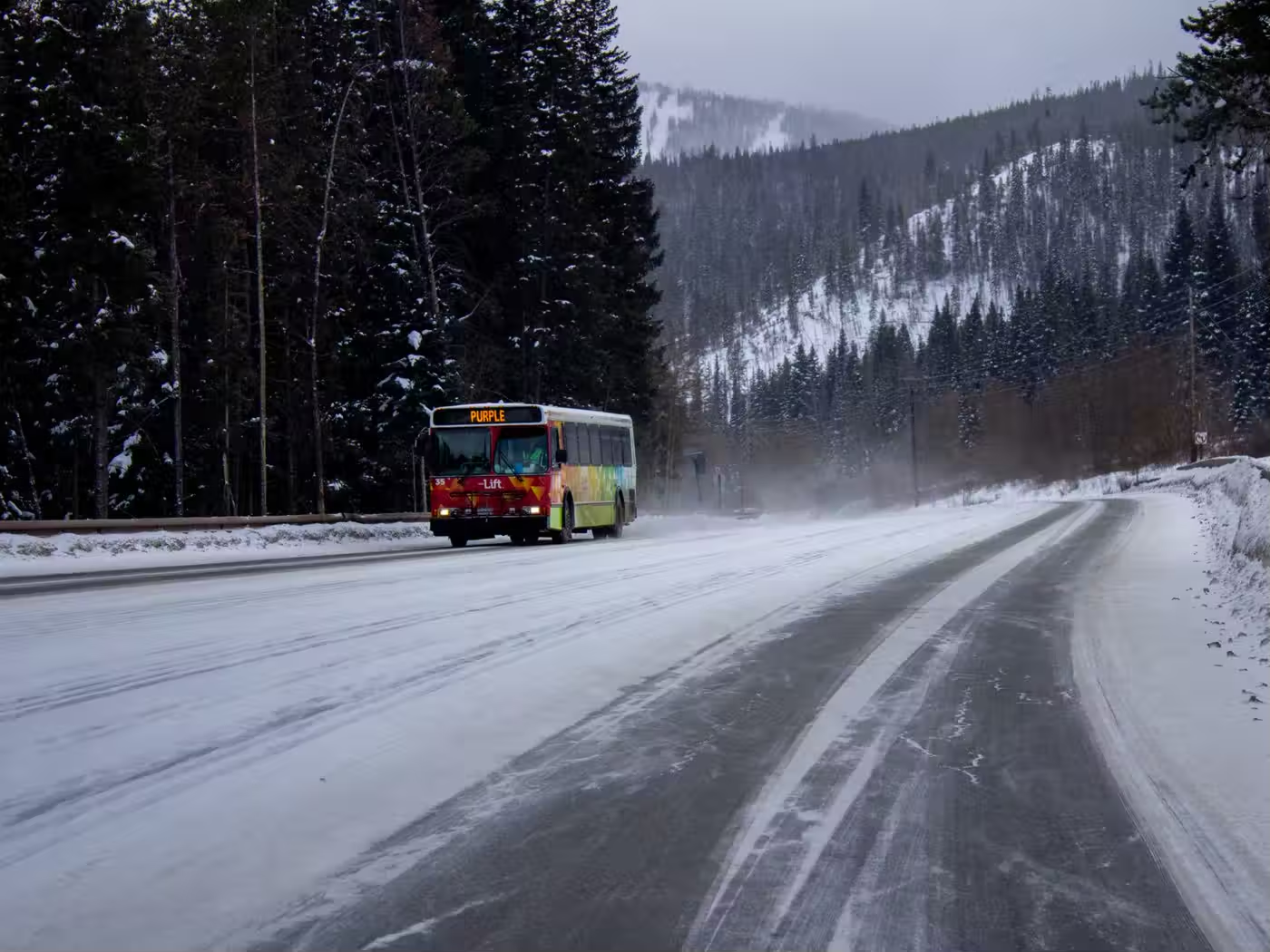
Seattle is one of the few large American cities with several ski areas inside a plausible day trip. That is a gift if you are organizing a weekend for a group of friends, a ski club outing, or a company day on the snow. It is also the reason the mountain lots fill before most people have finished their first coffee.
If you are planning a November or December trip for more than eight people, transportation is the decision that shapes everything else. Get it right and the group arrives together, warm, at a lot they do not have to fight for. Get it wrong and half your party is still on I-90 when the first chair has been spinning for an hour.
This guide covers the four Washington destinations Seattle groups actually use, the winter rules that apply to buses specifically, where ski equipment goes, what a realistic full day costs, and why HR teams keep coming back to a single vehicle with one fixed return time.
Why one bus beats a convoy of cars to the pass
A convoy sounds simple until it snows. Five cars leaving from five neighborhoods becomes five arrival times, five parking outcomes, and at least one text thread about who has the lift tickets.
The winter driving argument is the strongest one. Most people in a Seattle office drive in snow a handful of times a year. A commercial driver working mountain routes does it as a job, in a vehicle that is required to carry chains all season. The people in your group who are quietly dreading the drive home in the dark, after a full day of skiing, are the reason a chartered vehicle gets approved.
Then there is parking, which has quietly become the binding constraint at Washington ski areas rather than lift capacity. Crystal Mountain requires a parking reservation for guests arriving on Saturdays, Sundays and holidays. Stevens Pass requires a reservation to park before 10 a.m. on a published list of peak weekend and holiday dates. Multiply that by five cars and you have five reservations to win, on a system that rewards people who book early and punishes the group that is still deciding.
One vehicle also means one arrival for lift tickets, rentals and lessons, which is the difference between a group lesson starting on time and a group lesson starting twice.
The four destinations Seattle groups actually use
Snoqualmie Pass is the closest and the reason "bus to Snoqualmie Pass" is a real search. The Summit at Snoqualmie describes itself as about an hour from Seattle on I-90, and its own directions page sends traffic to different exits, 52 through 54, depending on which base area you want. That matters for a bus booking: name the base area in the itinerary rather than writing "Snoqualmie Pass" and hoping.
Stevens Pass publishes its distance clearly: 78 miles from Seattle, and 2 to 2.5 hours, via US 2. It is the classic Seattle day trip when the Snoqualmie forecast is rain and the Stevens forecast is snow, and it is far enough that a late return needs to be planned rather than assumed.
Crystal Mountain sits roughly 70 miles southeast of the city, reached by SR 410 through Enumclaw and then a final climb up Crystal Mountain Boulevard. That last stretch is the part to ask your operator about, because it is mountain road, and SR 410 is closed east of the resort entrance through the winter.
Mt. Baker is the long one. The ski area's directions take you north on I-5 and then east on SR 542 for roughly 40 miles of mountain highway, and its own page does not publish a Seattle drive time. Treat Baker as a full day with an early departure, and ask the operator for their realistic estimate rather than trusting a mapping app that does not know about snow.
What Washington's chain rules mean for a bus
This is the part most groups have never had to think about, and it is genuinely useful to know.
WSDOT's chain rules for vehicles over 10,000 pounds gross vehicle weight rating apply to buses, not just freight trucks. From November 1 through April 1, those vehicles must carry chains at all times on the relevant routes regardless of road conditions or advisories, and that route list covers all four destinations above: I-90 between North Bend and Ellensburg, US 2, SR 410 and SR 542. Vehicles must also carry at least two extra chains beyond the set in use, and plastic chains are not accepted.
Practically, this means the vehicle you book should already be equipped, and the driver should already know the chain-up areas. It also means that when the state escalates to a full chain requirement, your bus stops and chains up like everyone else. Build that into the day rather than treating it as a surprise.
Ask your operator two questions: does this specific vehicle carry chains for these routes, and has this driver run the mountain route before. Any operator working Seattle ski season should answer both without hesitating. Buslane connects groups with operators who meet our published standards, and winter mountain capability is exactly the kind of detail worth confirming directly with the operator before you sign.
Where the skis and boards actually go
Equipment is the quiet vehicle-selection factor. Fifty people with skis, poles, boards and boot bags is a large volume problem, and it rules some vehicles in or out before capacity does.
A full-size charter bus at 50 to 56 passengers has underfloor luggage bays and is the most straightforward answer for a large group with gear. A minibus at 24 to 35 passengers is the workhorse for mid-size groups, but bay space varies significantly between vehicles, so it is worth asking for specifics rather than assuming. Smaller vans can struggle once every seat is filled and every passenger has a board bag.
Policies differ by operator. Some require equipment to be bagged. Some will not allow wet gear or loose poles in the cabin. Ask what is allowed on board, what must go underneath, and whether wet boots are an issue for their interior. It is a two-minute conversation that prevents a curbside argument at 6 a.m.
What a full ski day actually costs
Most Seattle charter minimums sit at 3 to 4 hours. A ski day is not that. From a city pickup, out to the mountain, through a full day on the hill, and home again, you are booking 8 to 12 hours, and you pay for the waiting time in between because the vehicle and driver are committed to you.
Work an example at 10 hours. A charter bus runs $150 to $275 per hour, so the vehicle lands around $1,500 to $2,750. Split across 50 riders that is roughly $30 to $55 per person. A minibus at $125 to $200 per hour comes to about $1,250 to $2,000 for the same 10 hours, or roughly $42 to $67 per person across a group of 30. These are illustrative figures built from published hourly rates, not quotes.
Two additions belong in the budget from the start. Driver gratuity is commonly 10 to 15 percent for charter buses and minibuses and is almost never included in the quoted rate, which our guide to driver gratuity covers in more detail. And overtime, if the mountain sends you home late, is charged at whatever your contract says. Read that clause before ski season, not during it.
Get a quote for your group's ski day and you can compare full-day pricing against the 3 to 4 hour minimums you may have seen quoted elsewhere.
Company ski days and winter team offsites
The corporate version of this trip is genuinely different from the social one, and it is the reason ski charters show up alongside the rest of corporate group transportation in Seattle.
What HR and executive assistants like is not the bus itself. It is the fixed return time. One vehicle, one departure, one arrival back in the city means a company ski day has a defined end, which matters when some attendees have childcare pickups and some are flying out that evening. It also means nobody who has spent the afternoon in a lodge bar is driving a mountain road in the dark, which is the risk conversation most companies would rather not have.
The second thing is the headcount. A single vehicle gives you an exact list of who boarded and who is coming home, which is far harder to track across a carpool. For a winter retreat that combines an offsite meeting with a half day on the hill, the bus doubles as the travel window where the group is actually together.
If you are weighing this against the rest of the year's group travel, our Seattle group transportation overview covers how the same vehicles get used across corporate, event and social bookings.
Build the buffer into the booking
Winter adds variables that a summer charter does not have. Snow slows the drive up. A chain requirement adds a stop. Weather can close a pass with no notice. Ski groups also reliably underestimate how long it takes 40 people to get from the last run to the parking lot with all their equipment.
Three practical moves. Book more hours than your ideal itinerary needs, because extending a booking on the day is harder and more expensive than releasing time you did not use. Set a departure time from the mountain that is earlier than the lifts closing, and tell the group in advance. And ask, before signing, how overtime is charged and what happens contractually if a pass closure prevents the return.
When to book a November through March trip
Search interest for ski transportation from Seattle peaks in January, climbs through November and December, and drops off quickly after March. Operator availability follows the same curve, and the dates that go first are exactly the ones groups want: Saturdays, and the stretch around the winter holidays.
If you are reading this in the autumn planning a January company ski day, you are early, which is the right place to be. Confirm the date, confirm the resort's current-season parking policy for that date, and confirm the vehicle. The rest of the itinerary can move around those three fixed points.